Wednesday, June 5, 2013

Draft Work Proposal.


DRAFT WORK PROPOSAL craftACT 2013 


This body of work extends on the themes dealt with in a previous work entitled "Escape Artist". Escape Artist took the personal experience of chronic illness and social isolation and placed it in the philosophical context of Absurdist Existentialism to convey a narrative of imprisonment, suffering and despair which transitions to one of freedom and exhilaration. It's main intention was to highlight the transcendent power of humanity that can be found within the meaningless suffering and affliction that we are predisposed to as mortal, flesh and blood beings.


BOX 1: SPECTACLE

This new body of work, tentatively titled "Hope Chest" extends on the themes in "Escape Artist" by introducing historical, social and political contexts to the already existing philosophical viewpoint of Absurdist existentialism.
The first box entitled "Hope Chest: Spectacle" continues with the assemblage work , again making use of principles of Ostranenie - a box that is object but also strongly suggestive of the human figure. The box ilke elements such as the shape, the doors and the cross inlaid will suggest a medicine chest/first aid box but it will also have suggestion of a torso with legs and a head type piece on top. Again the chest opens out to view the insides. Elements used will strongly suggest a time period placing the box in the specific historical context of the 19th century. Other elements will suggest the human figure but with deformity, such as the handles which are ornate brass mispositioned hands. Inside the two inner doors will be decoupaged, one with a blown up photo of a freak in typical Victorian style portrait. The other vintage medical diagram. Inside will be a scene of classic Victorian period portraiture - an ornate frame against a an ornate wallpapered background with the inside frame featuring textile work that is suggestive of organic material: flesh but here flesh of a clearly uncontrolled and aberrant nature. The lighting and electricity suggest life force/humanity. The 'head' of the 'body' is crown like suggesting the new aristocracy of the body 
The point of this work is to place the disabled body in a particular time and place in history (the mid 1800 to the mid 1900s), thus  calling up the identity and representations given to disabled peoples at this point in history and, identify in the process, the social anxieties at work in the population as a whole. That is the collective anxieties of a population that found their resolution through projection onto the aberrant body.
Specifically for this time frame meant creating freaks out of those whose body did not fit current ideas of normal - the popular rise of the travelling Freak Show in Victorian times. As to what defined the normal body and the freakish body and why the body should become the site of so much projected anxiety the answer can be found in the social and economic changes taking place at the time. Significantly the introduction of liberal democracy as the defining ethos and the concomitant dismantling of aristocracy and birthright as a means of status to then be replaced by meritocracy. 
For the 19th Century citizen, iin the midst of economic and social upheaval density and status became a slippery commodity. Meritocracy suggested that one's status need be earned, that an individual could distinguish themselves through ability and their participation in the new democracy - in other words their future was a self determined one. Thus the disabled individual - the body that failed to determine itself within the norm - came to be seen as the embodiment of corporeal insufficiency  and deviance - a repository for social anxieties about such troubling concerns as vulnerability, control, identity and status.

Themes needing to convey:
Straddling ideologies of traditional and modern.
Commerce:
Curiosity:
Enfreakment:
Photographic iconography (the reproducible age as a precursor to mass culture):
Vintage medicine:
Religion: Still a sense of mystery.
Aristocracy vs. meritocracy:
The threat the disabled/sick embody: how to represent? Nails?


BOX 2: SPECIMEN

The second box makes the transition from the Victorian era into the modern era. The development of Modern medicine and it's growing authority recast the Victorian Freak into a subject of pathology, no longer paraded in carnivals for the ritualistic processing of collective anxieties but instead hidden from view - no longer available to the public to both reassure and threaten but the property now of a medical establishment who transformed them into specimen. The reliance on science and rationality, that had began in the Enlightenment, became a means of predicting and regulating an intractable universe, imperative now to ease the anxiety of a population uncertain of it's ongoing insider status in the new democracy.The disabled were no longer freaks to marvel at but examples of medicine's failure to correct, control or master the aberrant body. But the disabled, deformed and sick body didn't just betray the promise of medicine - whose key role it could be argued was to restore it's subject to viable participation in liberal democracy - but betrayed the key tenets of liberal democracy itself. The body that could not be fixed, controlled  or cured flew in the face of such concepts of self determination, self government, autonomy and progress almost mocking the liberal social experiment.  For this - a conflict unresolvable within the liberal paradigm - the only solution was to invalidate the disabled population. Now not only did the disabled continue to suffer outsider status, the associated stigmatisation and embody the role of cultural 'other' - again the repository for the anxieties of those who fear they may too one day, through illness or accident, be rendered 'other' - but now the threat they posed to the ideology of the times - had them hid from view.

This box will be larger than the others and more modern, streamlined. There will be much use of clean sanitised materials such as white opaque perspex. The textiles/flesh will be orderly and strung accuse frames of stainless steel.. The inside doors decoupaged will be enlarged bloodwork analysis one side and on the other enlarged stock market printout. Both obscured  by the size but still enough to know that the body has been ordered and the suggestion that it has been ordered in line with the socio-political economic environment.
How to suggest though the hidden fears/ 'sleeping terror' that inspires such control???? Nails???

Themes need to convey:
Fear:
Control:
Abandonment of God:
Dehumanised:
The threat and betrayal of cultural values that the disabled /sick symbolise: ie For this they are punished,dehumanised and invalidated. What are we so afraid of? "The sleeping terror" we project onto the disabled?? Is it that they betray the 'fantasy of autonomy' that underlies our liberal democracy?????????


BOX 3: SUBVERSION


Monday, May 13, 2013

Research.


It has taken a little while to realise that at the heart of my motivation for this new work is a desire to workshop the loneliness and isolation experienced in those long years confined to home and bed in the Nineties. I need, it seems, to be really clear on one thing. And that is despite the relentless physical drama and suffering that played itself out in those years it paled starkly in comparison to the pain of isolation. I often think of those years, which spanned nearly a decade, as containing something of an almost inhuman quality. There was a sense I was being denied something very basic. And yet that something had nothing to do with illness. Anchored as we are in the sheer corporeality of our body we know, even if only at a subconscious level, that we are vulnerable to disease and physical trauma. We can and do live with that in a way that is, although difficult, quite natural. What feels much less natural is to have your social identity stripped from you for those very same reasons and to know retrieving that identity is outside your control. It's one thing to be isolated physically, trapped in a room without company. It's a whole other thing to be struck off from existence while still alive. I assume  it's not called invalidism for nothing.

With this new work I want to explore the cultural and temporal aspects of illness and disability as a way of understanding the mechanisms at the heart of my experienced social isolation. That is to say it was not a matter of friends forgetting to phone  or not being able to leave the house (though that was the case). It was something way more contextual and complex: essentially the socio - political environment of the time.

So first a little historical diversion with some added cultural discourse from the relatively new field of disability identity politics....

BACKGROUND:

The political and socio-economic environment at a given time in history and the collective anxieties of the population regarding those compas points dictates the identity and social status afforded groups of  people. Those given identities are then represented in the culture in ways that not only project/reflect such anxieties but in ways that serve to reassure the privileged norm of their own cultural insider status plus remind them what the political system requires of them to hold onto that status.

If it is true that the margins define the centre in society then for anyone to have status there must also be a group of people relegated to the margins of society who do not have status.
In the mid Nineteenth century as the democratic experiment was taking hold and the old ideas of aristocracy and status were being dismantled and replaced with an ethos of merit, then ability became the means by which individuals distinguished themselves and attained status. It is interesting to consider that while the democratic experiment did away with ideas of institutionalised class, and championed an egalitarian ideal where all citizens could be considered equal, not much thought was given to the flawed nature of humanity, our insecurities regarding status and our need to know we belong. Therefore democracy needed to find it's margins - not only to reassure those who met it's requirements and thus belonged - but importantly to indicate what those requirements were.

And so the necessity for a group of people who simply in their being could symbolise what democracy was and, importantly, what it was not. Here, disabled populations, with their implied dependence on others - signaling a failure to meet democracy's most defining ideal ie the self determining individual - became by necessity not only definitive of the margins (and thus socially reassuring to those who were able bodied) but also symbolic of what democracy was not, confirming their social invalidation in the process.
In a way a new aristocracy - an aristocracy of the body - had replaced the old one of inherited birthrights.

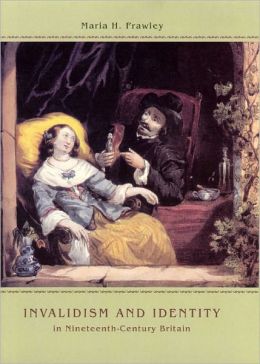
Thus it is not surprising that the anxieties of the population over the major cultural and political shifts taking place in the 19th C and their subsequent new identities in the new order should find their expression writ large on the body and it's physicality (and I take here the view of post structuralists in seeing the body as a site where social and political conflicts are inscribed, contested and resolved). Thus the rise of two phenomenon peculiar to this time in history -  in America the travelling Freak Show and in Britian the rise of 'the Invalid' as a specific social identity.

The Freak was able to serve as a figure of 'otherness' on which spectators could displace their anxieties. On one hand gain reassurance that they were within the bounds of normal and worthy of insider status while on the other a place to project their anxiety - after all the new social identity, dependent on good health and a 'normal' body as it were, was a capricious thing.

The decline of the Freak Show as the Victorian era came to an end coincided with the increasing status of medical science plus the increasing invisibility of the disabled person. This body of work will argue that the vulnerable body now not only symbolised a threat to individuals and their own status in society but the notion of liberal democracy itself.
The idea of a person living their entire life dependent on others flies in the face the ethos of individualism. And so the disabled figure becomes a very uncomfortable and almost impossible one for our culture to resolve. Their existence contradicts the defining ideal of liberal democracy (that we are self determining individuals) therefore to uphold belief in this idea the disbaled must be socially invalidate.
 Social invalidation speaks to our greatest existential fear - non existence - and this is the spectre that hangs as stigma over the disabled class and explains the threat and fear disabled people represent not only to our ideology but to our sense of selves.


Monday, April 8, 2013

Sideshow to Sidelined.


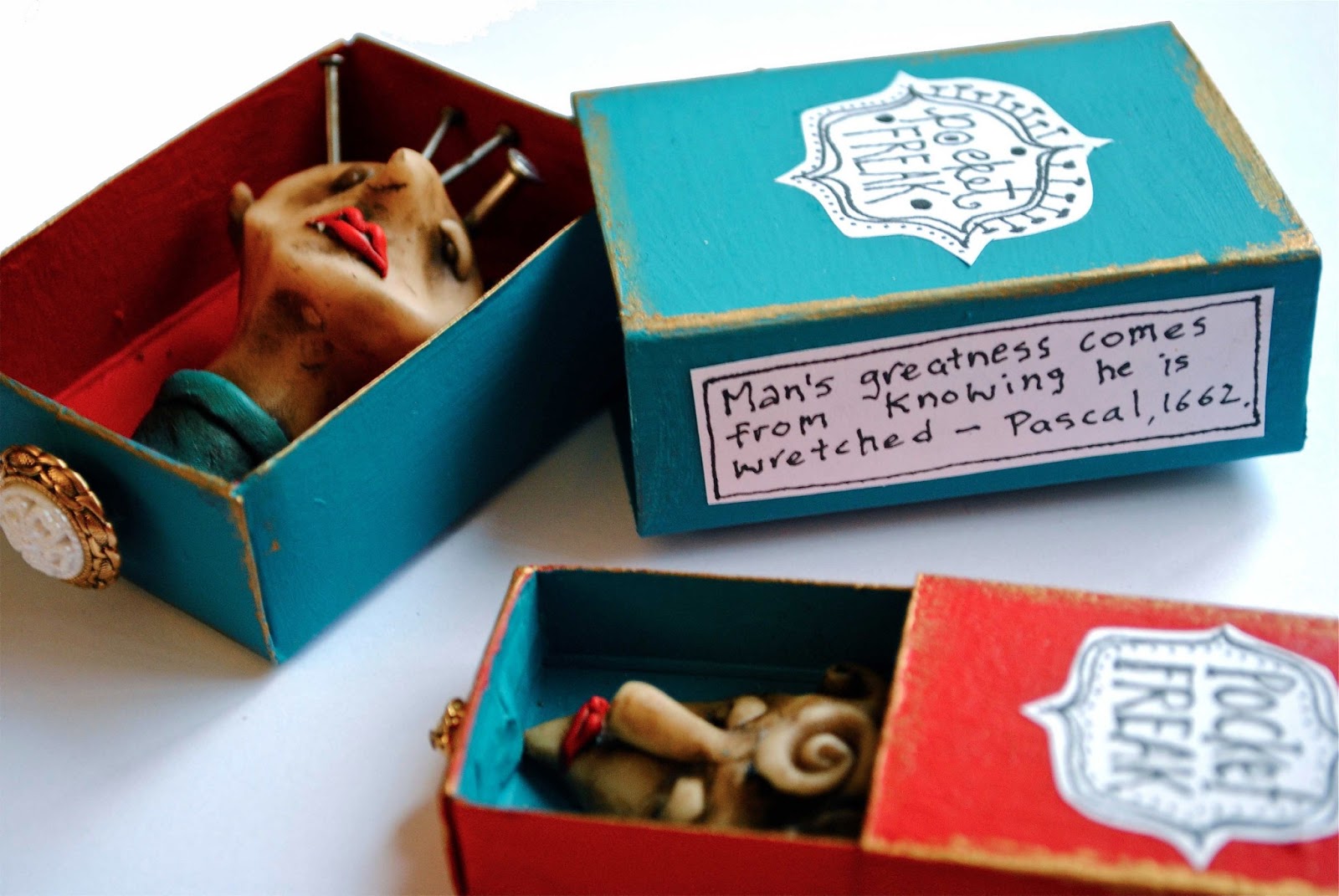
With this exhibition I've got lined up for November, exists an opportunity to extend on the work I did for the my graduate exhibition "Escape Artist" which is really exciting as one of the hardest things about last year was refining the work down to it's conceptual bones. Now to flesh it out so to speak. I have a new visual diary, lots of visual inspiration and now some macquettes - not of the work I plan to do but just giving some concrete form to early conceptualising. I've returned to the idea of Circus Freaks as my re-entry for a couple of reasons. First making the polymer freak for the graduate work was fun and I wanted to make more of them. Second the idea of a circus freak was central to the conceptual basis of the work - it tied together ideas of nature and physicality with ideas of absurdist existentialism. That is in circumstances that involve an enduring and meaningless form of suffering, as is often the case with the body, absurdist existentialism - accepting the absurdity inherent in meaningless suffering - can offer a way out of the suffering. Which is to tap into an unrelentingly bad and dark joke  - something I think the whole freak sideshow of a vintage circus does perfectly. For me the circus freak sideshow is the visual and conceptual manifestation of absurdist existentialism,  posing the threat we all live with (nature can be cruel) and asking the question how would you cope if dealt the bad hand? 
In times past this sideshow would give viewers the vicarious opportunity to experience that threat, testing their own strength along the way. Now (of course) that option no longer exists. A few years back while taking my kids out (to see Circus Oz of all things) there was a man in the ticket queue behind us suffering from, I assume Proteus Syndrome (elephant man disease). I kept trying to keep my kids looking ahead or engaged with talk so they wouldn't look back and be shocked/horrified or loudly voice their curiosity and embarrass me. Later we walked by him unexpectedly and I saw my little boys face as he caught sight of the man. My son was only three and at first he did seem shocked but then you could see him trying to make sense of what he had seen. For my part I didn't say anything but only because I had no idea what was the PC thing to say or do. Moreover I suspect whatever I'd said would only have served to project my own fears.
So in effect I ignored what my son had experienced. All of which made me feel quite pathetic and cowardly. And I guess that is why people are sometimes cruel to those who are different, out of anger at being faced with their own fears and pathetic nature. Someone who is supposed to be the vulnerable, inferior one just made you feel vulnerable and inferior.

With my graduate work I argued (with the help of absurdist philosopher Albert Camus) that the freak had the last laugh. That embracing the absurdity, transcending the fear of what nature is capable of, offers a transcendent kind of freedom and the opportunity to connect most fully with what it means to be human - subject to nature's caprice with all its entailing fragility, vulnerability and transience - those things we find most frightening.
So this is where my thoughts are heading: As evolved as we may be to no longer parade those misfortunate souls around to satisfy our curiosity and vicariously face our fears - and with science  demystifying physical deformity and disability (guess what? Your virtue wont protect you) and eradicating much of it - what has become of our fear that one day we may be the sidelined one?

I would probably argue that we are more now, than at any other time, beholden of our fears (and thus less tolerant of) the unfortunate individual who simply by their existence threatens both our sense of immortality and our modern entitlement to the 'good life'.
Moreover, and I'd say most importantly, our sense of belonging too. For I think there is actually less public space available to the afflicted than there ever was. We might tell ourselves otherwise as we put handrails up in public toilets and ramps around buildings but all that tells me is that we are okay with the wheelchair. Down with the complexities of useless legs. It's such a narrow interpretation of disability and inclusion it could be a joke  (insert bitter laugh here).
Worst of all the modern 'freak' who nature has rendered so useless as to be unable to contribute to economic growth - let alone simply support themselves - threatens us with our biggest existential fear of all - complete invalidation. For whatever point of existence could be attributed to them now? No wonder is our need to have them completely out of sight.
So without the benefit of the circus side show freak where might someone these days get the opportunity to confront those kind of fears? Unless you are given to lurking the corridors of hospitals (those particularly sanitised environments which evoke a telling sense of the surreal on entering) eavesdropping on all the human misfortune being played out within it's walls - or visiting a region beset with entrenched poverty - then it is unlikely the un-afflicted (that's not actually a word, sorry) need be confronted with the afflicted. At what cost to them/us I wonder?

Here's another thought: Can you imagine someone in a Medieval Europe as the Black Plague was devastating their village, noticing the first signs of illness in themselves and thinking "why me?". Would the village hunchback prefer to be transported to now where he might get a disgnosis and an uncomfortable metal brace to wear in public or prefer to stay in his medieval village where he could continue mixing it up with the village madwoman (undone by her endless grief), the village consumptive (an immune deficiency) and the village idiot (bad case of infantile measles). Okay, maybe I'm tired and need to wrap this up or maybe I'm trying to get at something.
I guess with this next work I want to introduce some temporal and cultural contexts. Ideas about modern entitlement and how that conflicts with the vagaries of nature we still remain powerless to control, plus the implied role of a market economy - the selling of physical perfection, disengaging us from our humanity. Related ideas of spirituality, authentic living too. 

Thats it for now. If you made it this far thank you. Feedback and discussion welcome.

Sunday, October 28, 2012

Stitching The Heart.

h
This technique of stitching the heart onto the wire (which I used on the lungs)  had always been my intention. I was delaying it though because i liked the way it looked on the clamps and I was worried also I'd mess it up or just be disappointed with the outcome and not know where to go next. It took a second go of doing but I'm really happy with it. Like the way the stretched silk and wool has a membraneous living tissue feel. The stitching also emphasises the whole textiles themes, both personal (the desire to live in the physical world and have a useful physicality) and a more generalised fascination that our anatomy IS of such physical matter, maybe as vulnerable and delicate as the silk and wool.

More progress with the felting technique and wire.


Felted shapes pinned to wire. At this point not sure how to attatch.


These white coat hanger/cobwebby felting things are the lungs. I tried first to make the shape of the wire the felting was going to fit in and the stitch it on (left triangular shape). Then I got the idea (remembering last years textiles class - god bless Barb for her thoroughness) I could actually felt the wire into the wool ( thus bypassing the stitching). The little circle cocoon was a practice piece and I thought this was pretty cool. So off I went and did that for both lungs (are they called lobes? Should look that up...)...
Anyway this is how that worked out and at first I was pleased and then on further rumination realised I wasn't really pleased. Which felt crap because I didn't know where to go next...


So onward. I decided to redo them and hope for better. Using sharp scissors I cut the felt shapes off at the boundary. I liked how they held their shape. Then I figured on stitching them back on using the stitching to further the conceptual aspects. It took three goes to get the stitching right but finally I'm happy(ish) enough with them. Next the heart.


Monday, October 22, 2012

Progress with textiles and anatomicals.


Played around with some wire to get these abstracted anatomical shapes. The wire is important because it is very coat hanger like and I hope (I think) to have them hanging like coat hangers of a rail/rod inside the box/wardrobe. I cut some of this divine red silk to fit the heart frame and carefully felted the outsides, not sure in this instance how much shrinkage I wanted or would eventuate from the process. I wanted  a membraneous finish with the wool and the silk and I'm pretty happy with what I got, trading it off for some rippling off the chiffon. The end result was smaller than in the photo shows, but was able to be stretched taut with in the frame with same mini clips (bought from office works on a whim - I knew they'd come in handy!). I intend to stitch the heart/textiles to the wire frame (trampoline-esque) but for the time being I like this clamped effect. What do you think (feedback please)?

Wednesday, October 3, 2012

In Need of Felting Skills Fast.


Having decided on textiles as a significant component of my work, to represent the anaotomical, I've settled on wool and Nuno felting. This is after many various other trials with calico, raw silk, transfers etc etc which seemed to fall short of what i wanted. Unfortunately I don't have a lot of experience with felting though I know that it is incredibly versatile and can create various beautiful textures. So a lot of playing. Or maybe it would feel like playing if it wasn't such a labour intensive process or I wasn't sick. Or didn't feel obsessively aware of the deadline. Or had more experience....
So lots of trials. The most successful for the 'heart' seems to be with some beautiful cherry coloured silk chiffon and Nuno felted around the edges with different shades of red marino tops (the upside of this preocess is the gorgeous materials). Eventually I got what I wanted but now I need to perfect the shape and decide on the wire structure. Progress I think.

Tuesday, September 25, 2012

Box One and Box Two

Midsemester reviews tomorrow and I really need to clarify my thoughts. Fortunately remembered how useful the blog has been for this so here goes....
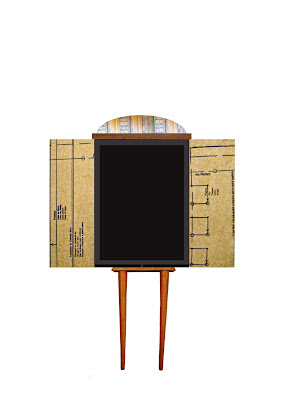
These two boxes - not actually made yet, these are just digital mockups - are about 420mm x 31mm x 120mm. Thats not counting the 'head' and 'legs'. Hopefully the first thing you are getting from them is some Ostranenie. It would be good too if you were getting generalised pictures of alters, closets/wardrobes and even coffins. 
 
Box 1 on the left is about the self existing in the physical and material world.  This world has strict limits for defining life and it's prescriptions fall into quite narrow boundaries. It's almost like a recipe - enough calcium, sodium, amino acids all in the right proportions and you can have perfection. If your physical self falls into those narrow boundaries then lucky you, you get to have a life. For a while anyway. Because here's the bad news about the first box: material things don't last, they are temporary and they decay, inevitably, crumbling around you as though you are all artifice. If you are wholly wedded to this physical world (just like our culture with it's emphasis on youth, beauty and physical prowess) then does the crumbling artifice cancel you out of existence? If not, what is left? 
Box 2 attempts to make some sense of what is left when the physical and material world are unavailable to you or are insufferable. It attempts, from my own experience with disabling illness, to visualise an alternate world not reliant on the body or even the mind.
Two key inspirations have helped inform this vision. The existential/absurdist vision and the metaphysical vision. (Bit worried they are theoretically incompatible. Need more research here, but nonetheless this is my experience...). The metaphysical, takes inspiration from a poem by Franz Kafka (not co incidentally Kafka is considered an absurdist philosopher which may solve my incompatibility problem)  which reflects the essence of life as something that is all around and within and does not need an able body or even a particularly erudite, functioning mind to experience. (Halellujah). With a certain transcendence the world can come to you 'reveal itself, it has no choice, it will roll in ecstasy at your feet'. Not only is it a beautiful vision but it reveals also the cosmic joke - that life was right there in front of you, all the time you spent looking for it, like a lost sock.
The existentialist/absurdist vision is one I hold dear as it became the only framework within which I could comfortably view my otherwise inexplicable circumstances (the constant why?). Not far from this framework sits my notion of a vintage circus with it's sideshow of freaks, excluded from the mainstream, watching 'life' from the sidelines. In my vintage circus they are not the joke. Instead with their unique position on the sidelines, they are audience, watching the rest of us play out our proscribed lives and they get the joke. That's the advantage of being on the sidelines, the head start on life's cosmic joke, and they are in on it from the start - the existential comedy*, the one that reveals itself to us all through pain and suffering sooner or later. 
The upshot? Box One will let you down. It's definition of life is exclusive and self limiting and it's material nature means an inevitable decay with no back up plan. 
Box Two is enduring. It allows for transcendence of the material world and it's in on the cosmic joke. 

*The existential comedy - that there is no meaning. Suffering is senseless but happens anyway. This position allows a detatchment from life's insults and appreciation of the joke.

Monday, September 17, 2012

Zombies Hate Stuff.


Decided today there aren't enough humorous watercolours out there. That's why it's so great to see artist Greg Stones get his book Zombies Hate Stuff published. Through a series of stand alone paintings Greg Stones shows us what kind of things Zombies hate which is quite a lot. Generally they seem quite disgruntled. For example they hate clowns, they hate weddings and they hate having to share. They also hate sheep, re-gifting and war re-enacters (I am with them for war re-enacters but find re-gifting if done with care can be a really green solution to household clutter).
Other things Zombies hate are:

Disrespect

Hippies

Unicorns.

Read Greg Stones interview with himself HERE:

Re-gifting.

Saturday, September 8, 2012

Visit To Megalo Exhibition.


So enjoyed my visit to the Megalo exhibition I thought it needed a post of it's own. Two standouts for me - Franki Sparke's zines (above) because of the wonderful graphic qualities in his woodcuts plus the quirky, humorous themes contained within. I LOVE zines and here you are able to buy one of them and take it home (affordable art!) - five to choose from - it took ages to make a decision. The other artist was  Arthur Desmarteux. The word 'awesome'  is so overused but Arthur's work could pretty much own the word. I desperately wanted to paste some of the exhibited silkscreens into this blog but images from his site are non html so go straight to the source here if interested. Below is an etching of his I found of the web that gives you an idea of his style sans the characteristic colour explosions in the silkscreens.


An off the web woodblock print of Frank Sparke below.


Even if you are only vaguely interested in printmaking and artist books I reccommend that you go, go, go to this exhibition before it ends. Glad I did.